

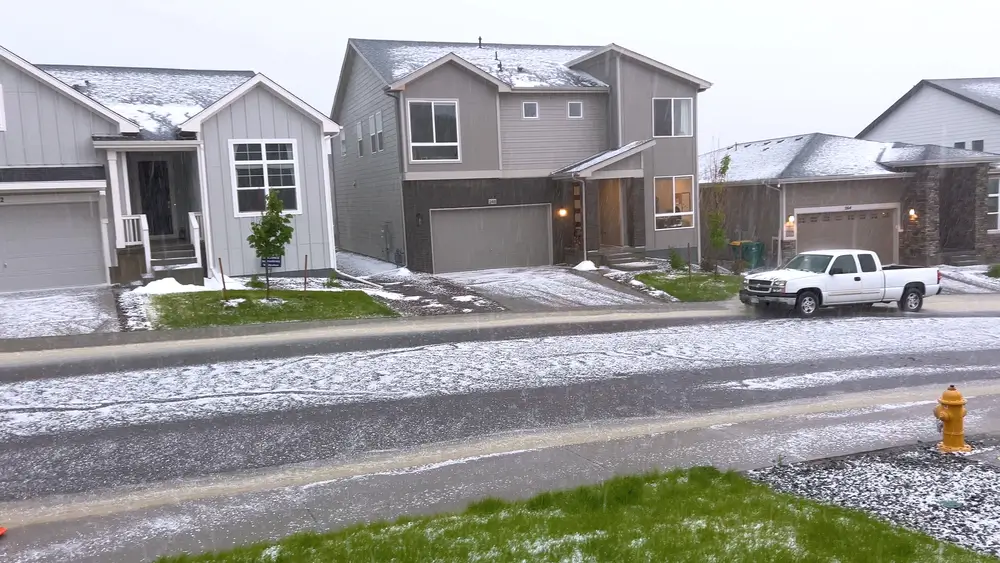
In Colorado, hail damage roof repair runs from a few hundred dollars for a small spot repair to $8,000 to $20,000 for a full asphalt shingle replacement on a typical Denver-area home. When insurance covers the damage, most homeowners pay only their deductible, which may be a flat amount or 1% to 5% of the home’s insured value.
The sections below explain where your roof is likely to fall in that range, and what decides your out-of-pocket share.
How much does hail damage roof repair cost in Colorado?
Cost depends on how much of the roof was hit. These are planning ranges before insurance.
Scope of work | What it usually includes | Typical cost |
|---|---|---|
Spot repair | A handful of shingles, sealing, one or two vents | $300 to $1,500 |
Partial repair | One slope or several roofing squares, plus flashing and vents | $1,500 to $8,000 |
Full replacement, asphalt shingles | Tear-off and a new roof system | $8,000 to $20,000 |
Full replacement, metal | Tear-off and new metal panels | $18,000 to $40,000 or more |
A roofing square is 100 square feet of roof surface. Gutters, downspouts, window screens, and paint are often damaged in the same storm and can be added to the same claim.
For a full breakdown by roof size and material, see our guide to roof replacement cost in Denver.
What drives the cost of hail repairs?
- Extent of damage. Hits on one slope cost far less than hits on every slope.
- Roof material. Metal, tile, and specialty shingles cost more to repair than standard asphalt.
- Pitch and complexity. Steep roofs and roofs with many valleys or dormers add 15% to 25% in labor and safety setup.
- Decking and underlayment. Hidden damage under the shingles is only confirmed once the old roof comes off.
- Code requirements. A replacement has to meet current local building code, which can add items your old roof did not have.
- Shingle matching. If your shingle line has been discontinued, a patch may not blend, and that can push a repair toward replacement.
- Timing. After a major storm, demand for crews and materials rises across the Front Range, and prices can rise with it.
Repair or replace: how is it decided?
Inspectors and adjusters mark off test squares, usually 10 feet by 10 feet, on each slope and count the hail hits inside them. A few hits on one slope points to a repair. Consistent hits across several slopes points to roof replacement, because patching cannot restore a roof that is bruised everywhere.
Each insurer sets its own threshold. Roof age matters too. Older shingles turn brittle, and they often break when a roofer lifts them to replace a neighbor.
What will you actually pay if insurance covers it?
Standard Colorado homeowners policies cover hail. Your share comes down to three things on your policy.
- Your deductible. Some policies carry a flat deductible, such as $2,500. Many Colorado policies now carry a separate wind and hail deductible of 1% to 5% of your dwelling coverage. On a home insured for $500,000, a 2% deductible is $10,000.
- Replacement cost or actual cash value. A replacement cost value (RCV) policy pays the full cost of the new roof, minus your deductible. It usually pays in two checks, with the second released after the work is done. An actual cash value (ACV) policy subtracts depreciation for good, and on an older roof that can be thousands of dollars.
- Exclusions and schedules. Some policies exclude cosmetic damage, such as dents in metal that do not leak. Others pay a set percentage based on the age of the roof.
Here is how that plays out on a $16,000 replacement:
- RCV policy with a $2,500 deductible: you pay $2,500.
- RCV policy with a 2% deductible on a $500,000 home: you pay $10,000.
- ACV policy with 40% depreciation and a $2,500 deductible: the insurer pays $7,100 and you pay $8,900.
These are illustrations, not quotes. Your declarations page shows which of the three applies to you.
Can a roofer waive or cover your deductible?
No. Colorado law bars roofing contractors from paying, waiving, or rebating an insurance deductible. A contractor who offers to cover it is asking you to take part in insurance fraud. Treat the offer as a reason to hire someone else.
Is a hail claim worth filing?
It depends on how the repair cost compares to your deductible.
- If the estimate is below or close to your deductible, paying cash is usually simpler.
- If the estimate is well above your deductible, filing is usually the right call.
You need a real number before you decide, so get the inspection first. Our Colorado roof insurance claims guide covers the filing steps, and Premier provides insurance claim support through the adjuster visit.
What does waiting cost?
A bruised shingle that is not leaking today can leak after a winter of freezing and thawing. Then the bill grows to include decking, insulation, drywall, and sometimes mold cleanup. Policies also limit how long you have to report storm damage. Once that window closes, a repair that would have cost your deductible becomes fully out of pocket.
Can you lower the cost of the next storm?
If you are replacing the roof anyway, ask about Class 4 impact-resistant shingles. They cost more upfront, but they hold up better to hail and may earn a discount on your premium. Ask your insurer what they offer before you choose.
How do you get an exact number for your roof?
Online ranges only get you so far. Start with a quick check of your own using our checklist on how to spot hail damage from the ground (link to Spoke 1). Then book a free roof inspection. We document the damage, tell you whether it calls for repair or replacement, and give you an itemized estimate you can compare with your deductible.
If the storm was recent, follow the steps in our guide on what to do after a hail storm so your documentation is in order. When you are ready, our team handles residential hail damage repair across the Denver metro.
Frequently asked questions
How much does it cost to fix hail damage on a roof in Colorado? Spot repairs often run $300 to $1,500, partial repairs $1,500 to $8,000, and a full asphalt shingle replacement $8,000 to $20,000 on a typical Denver-area home.
Does homeowners insurance cover hail damage in Colorado? Yes, standard policies cover hail. What varies is your deductible and whether your roof is insured at replacement cost or actual cash value.
Will I pay more than my deductible? Not usually on a replacement cost policy. On an actual cash value policy, you also absorb the depreciation, and upgrades you choose are your own cost.
How long do I have to file a hail claim? Filing windows vary by policy, so check yours soon after the storm. Early claims are also easier to tie to a specific storm date.
Not sure what your hail damage will cost? Get a free, no-obligation inspection and itemized estimate.
Premier Restoration & Construction serves the Denver Metro area and Summit County. Call 303-773-6437 or schedule your free inspection.