
- By tecmobeto
- Residential Roofing
- 0 Comment
Replacing your roof is one of the biggest home investments you’ll make — and in Denver, it comes with a few extra wrinkles that homeowners in other states don’t have to worry about. Hailstorms, intense UV from altitude, hard freeze-thaw cycles, and heavy spring snow loads all put Colorado roofs through the wringer. When the time comes, knowing what to expect makes the whole process a lot less stressful.
This guide walks you through every stage of a residential roof replacement in Denver — from the first signs that a new roof is overdue, all the way to what your finished project looks like and how to care for it.
How do you know it’s time for a roof replacement?
This is the question homeowners ask most often, and the honest answer is: it depends on more than age alone. Here are the signs that typically point toward replacement rather than another round of repairs:
- Age of your roof. Asphalt shingles in Colorado typically last 20–25 years under normal conditions. If yours is approaching or past that range, a replacement is almost always more cost-effective than continued repairs.
- Widespread shingle damage. Cracked, curled, or missing shingles across large sections of the roof — not just a small patch — are a clear signal that the whole system is failing.
- Granule loss. If your gutters are full of gritty, sand-like granules, your shingles are deteriorating. Granule loss accelerates moisture damage and signals the end of a shingle’s useful life.
- Persistent leaks or water stains. One isolated leak can be repaired. Stains on multiple walls or ceilings, or leaks that keep coming back after repairs, suggest the roofing system is compromised beyond patchwork fixes.
- Sagging or uneven roofline. This points to structural issues beneath the shingles — decking or framing damage — that require full replacement to address properly.
- Moss, algae, or significant organic growth. A little moss isn’t unusual in Colorado, but heavy growth traps moisture and accelerates rot. If it’s widespread, the damage underneath is likely significant.
- Frequent repairs. If you’ve had two or three roofing repairs in the last few years, you may be spending more than a replacement would cost.
Not sure which side of the line you’re on? Our blog on roof repair vs. replacement in Colorado breaks down exactly how to think through that decision.
What’s the best time of year to replace a roof in Denver?
Spring and fall are ideal — mild temperatures, lower humidity, and more predictable weather windows. Late April through June is a sweet spot, which is part of why this is one of the busiest times of year for Denver roofing companies.
Summer works well too, though very high temperatures in late July and August can make asphalt shingles harder to install cleanly. Early summer is fine.
Winter replacements are possible and sometimes necessary after storm damage. Cold temperatures make shingles brittle and require extra care during installation, but a skilled crew can handle it. Some contractors offer off-season pricing discounts in the slower winter months.
The main takeaway: don’t wait until your roof is actively leaking to schedule. Book ahead, especially in spring, when demand is high after the first hail storms of the season.
The Denver roof replacement process, step by step
Step 1: Free roof inspection
Every replacement at Premier starts with a free roof inspection. Our team assesses shingle condition, flashing, underlayment, ventilation, decking, gutters, and any storm damage. We document everything with photos and give you a clear, honest picture of what’s going on up there.
If you’ve had a hailstorm recently, we’ll also assess whether damage is likely to be covered by your homeowner’s insurance — and help you navigate that process if so.
Step 2: Material selection
Most Denver homeowners choose architectural (laminated) asphalt shingles, which offer a good balance of durability, aesthetics, and cost. But we also install metal roofing, which lasts significantly longer and holds up better in Colorado’s climate extremes. During the consultation, we’ll walk you through:
- Shingle brands and warranty levels (30-year vs. 50-year architectural)
- Impact-resistant (Class 4) shingles, which can reduce your insurance premium
- Color and style options that work with your home’s exterior
- Whether your ventilation system needs upgrading alongside the new roof
Step 3: Scheduling and permits
Once you approve the estimate, we handle the permitting process with your local municipality. In Denver and surrounding areas, a roofing permit is required for full replacements. We pull the permit, schedule your project, and confirm the timeline with you in advance.
Step 4: Tear-off
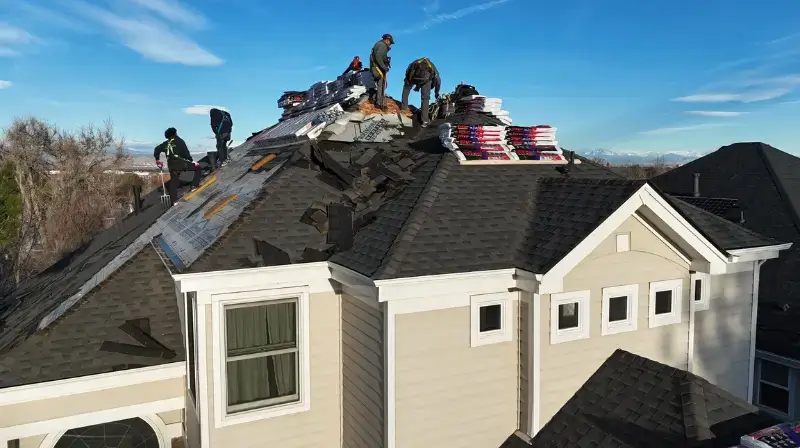
On installation day, our crew removes your old roofing material down to the decking. This is the noisiest part of the process — plan for a full day of sound. We protect your landscaping and driveway with tarps and staging areas, and we do a magnet sweep for nails at the end of each day.
While the decking is exposed, we inspect it for soft spots, rot, or damage. If we find problem areas, we replace those sections before laying the new system.
Step 5: Underlayment and ice and water shield
Before any shingles go on, we install synthetic underlayment across the full roof surface. In Colorado, we also apply ice and water shield along eaves, valleys, and around penetrations — this is critical protection against the freeze-thaw ice damming that’s common along the Front Range in late winter and early spring.
Step 6: Shingle installation
Shingles are installed from the bottom up, with proper staggering to prevent water infiltration. Flashing is installed or replaced around chimneys, skylights, vents, and wall intersections. Ridge cap is applied last, completing the weather seal across the peak of the roof.
Step 7: Cleanup and final inspection
We do a thorough cleanup of all materials, nails, and debris — including a magnetic sweep of the lawn and driveway. Our project manager does a final walkthrough with you to make sure everything meets your expectations before we close out the job.
Can you stay in your home during the replacement?
Yes, in almost all cases. Roof replacement is a one-day job for most standard residential homes. You’ll want to plan for:
- Significant noise throughout the day — if you work from home, a coffee shop might be a better office for the day
- Vibrations that can rattle items on shelves — secure or remove anything fragile
- Your driveway and yard being partially occupied by crews and materials
- Pets and young children kept away from the work perimeter
If you’d prefer to be out of the house for the day, that’s completely reasonable. Some homeowners just leave us a key and come back to a finished roof.
When is replacement more cost-effective than repairs?
A good rule of thumb: if repairs are going to cost more than 30% of a new roof’s price, or if you’ve already done multiple repairs in the last few years, replacement usually wins financially. A new roof also restores your full warranty coverage, improves energy efficiency through better insulation and ventilation, and eliminates the risk of hidden structural damage compounding over time.
How does insurance work for roof replacement?
If your roof was damaged by hail, wind, or another covered storm event, your homeowner’s insurance may cover most or all of the replacement cost. The process involves filing a claim, having an adjuster assess the damage, and coordinating the replacement around the insurance timeline.
At Premier, we work with homeowners on insurance claims regularly. We can document storm damage, provide detailed estimates for your adjuster, and make sure all damage is properly accounted for in the claim.
What does a new roof cost in Denver?
Roof replacement costs vary based on square footage, pitch, material choice, and the condition of the decking. We cover this in detail in our companion post on Denver roof replacement costs — but the short answer is that most Denver homeowners invest between $8,000 and $20,000 for a standard asphalt shingle replacement on a single-family home, with metal roofing running higher.
The best way to get an accurate number for your specific home is a free on-site inspection and estimate.
Ready to get started? Request a free inspection at premier303.com or call 303-773-6437.